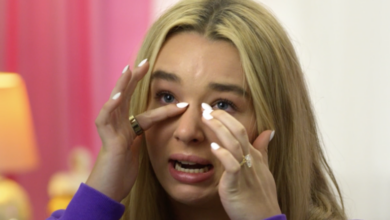
Baylen Out Loud’ Star Chokes Up: Fans Imitating Her Voice and Tics Isn’t ‘Cute’ — and What She Shares Next Makes Many People Stop and Look at Themselves

Baylen Out Loud’ Star Chokes Up: Fans Imitating Her Voice and Tics Isn’t ‘Cute’ — and What She Shares Next Makes Many People Stop and Look at Themselves
Baylen Dupree wandered through the residential streets of Los Angeles near Melrose in search of a spot to snap a few Polaroids, her fiancé Colin Dooley and her sweet dog Fluffy in tow. The photos would be for this story, just one stop on a press tour for her TLC show, Baylen Out Loud, which follows Dupree and her family as they navigate the everyday highs and lows of her life with Tourette syndrome. If being across the country from her Washington D.C. home, searching for a location to shoot photos to promote her hit show weren’t surreal enough, Dupree unexpectedly crossed paths with none other than Lisa Rinna, formerly of The Real Housewives of Beverly Hills, out walking her dog, too.
It’s a strange, only-in-LA moment — as if Hollywood itself is rolling out the red carpet for Dupree. It’s almost too much to take in, especially for someone who, just four years ago, was struggling to walk, talk, and even feed herself.
Dupree was diagnosed with Tourette syndrome at 18, but had a history of ticcing (involuntary repetitive movements or sounds) since the age of 7. She struggled with tics a bit in her childhood, but they subsided almost completely until she was 16. During her teen years, Dupree’s tics started off mild, but became more intense as she developed Coprolalia, a rare symptom of Tourette’s that manifests with outbursts of obscene or inappropriate language. It was a difficult time, marked by confusion from both her family and doctors. “The not knowing was the hardest part,” Dupree recalls during a Zoom interview from her apartment in D.C., a month before we meet in person in Los Angeles.
It was during the COVID lockdown that Dupree’s symptoms became debilitating. “I basically hid from everybody. I did online school for the rest of the year. I just became really, really insecure with myself. I was in therapy three to four times a week,” she says.
Instead of going back to school when lockdown was over, Dupree says she found it easier to hide her diagnosis and not “reintroduce herself” to her schoolmates for fear of being looked at as different. She didn’t even walk in her high school graduation, a milestone she always assumed she’d be able to celebrate. A brief attempt at college was cut short by her tics and a general lack of support in school.




Dupree looks back solemnly at this dark chapter in her life. “I didn’t want to be alive. It was the worst of the worst. I couldn’t walk. I barely left the house,” she says. “It was just the worst point in my entire life.”
But now, Dupree is the star of the TLC show that carries her name, and she’s widely recognized as an advocate for those with Tourette syndrome. She lives in her own apartment with her fiancé (we saw them get engaged on the show), and she’s living the life of a reality star. On the show, viewers watched Dupree accomplish a series of things she’d worried she never could — traveling on an airplane, speaking on a panel, and living independently, to name a few. For Dupree, it all came down to a choice: she could keep hiding, or she could live her life out loud.

At the height of her symptoms, an old high school classmate saw Dupree in a grocery store and filmed her ticcing. “That’s all I thought about the rest of the day,” she says. It was that harrowing episode that prompted Dupree to make a TikTok of her own, setting the record straight and publicly revealing her struggle with Tourette syndrome. For her, it wasn’t just about sharing the truth — it was about reclaiming her agency and refusing to hide any longer.
“I could only hide for so long before I started hating myself,” Dupree says. “I hated myself for so long, because I did not want to be who I was.”
On social media she could be 100% authentic. As she learned more about her disorder, she’d share it with her growing TikTok following — which to date has reached over 10 million followers. Looking back at those frightening days when she had no answers, sharing her story and other information on Tourette syndrome on a larger scale helped her process that trauma. Now, she feels like it’s her purpose. In fact, Dupree drops in facts about Tourette syndrome during the course of this interview ( “50% of people go undiagnosed with Tourette’s”).
“For God to be using me in this way and being this vessel for so many people is the biggest blessing in my life,” she says. “Because that’s the only thing I want out of it, other than Tourette’s awareness, is for somebody to feel like they’re heard, and they’re seen, and they have a community.”
After revealing her diagnosis, Dupree started posting videos about her life with Tourette’s and her day-to-day struggles during the pandemic. These videos were raw and honest, and sometimes as simple as showing what it’s like to bake a cake while living with Tourette syndrome. By sharing her everyday moments — like cooking or just getting through a typical day — she made her condition feel relatable. It wasn’t just about her Tourette’s, it was about her real, unfiltered life. This fueled her TikTok’s viral success, but as her tics worsened, there was speculation in the comments that she was faking it, leading her to pivot to be even more honest and open about her condition.
This honesty and her burgeoning social following also caught the attention of executives at TLC, who offered her and her family a television show documenting her life at an up-close and deep level. Though she feels sharing her story is her purpose, Dupree says it wasn’t an easy decision to make to air her whole life on television. Posting on TikTok is one thing, but the massive mainstream reach of a network like TLC is a different animal altogether. Though Dupree was used to social media scrutiny, she says that her family were less comfortable with that aspect of being in the public eye. Ultimately, though, the family got on board. “We came to this conclusion where it’s like,’ let God use us.’ We know that this is bigger than my siblings, this is bigger than me,” Dupree says. “This is for the tic community.”

The show primarily follows Dupree, but her parents and siblings are a big part of her life, and therefore a big part of the show. Dupree’s parents, Allen and Julie, guide her in her journey toward independence and grapple with their own fears about her gaining it. Dupree’s five siblings — Vick, Sammi, Sven, Burke and Bechnir — often appear with her in straight-to-camera interviews, cracking jokes and gently prodding one another in a pretty typical sibling fashion.
Dupree explains that she and her family had some trepidation at the start of production because they were entrusting TLC with not just their complex story, but the Tourette’s community at large. “In Hollywood, Tourette [syndrome] doesn’t look good,” Dupree says, citing the 1997 film Niagara, Niagara. But, she speaks highly of how the first season played out and the care and attention production took into telling her story.
Baylen Out Loud is a hit for a reason, and it clearly resonated with its audience, as the series garnered 14.7 million viewers in the month after its premier. Part of that success is likely the show’s unflinching and realistic portrayal of living with Tourette’s. In an episode where Dupree and her mother Julie attend TIC-CON (the official conference for the Tourette Association of America), Dupree goes through a severe tic-attack that leaves her incapacitated on the floor of a hotel. It’s difficult to watch, especially considering the attack occurred after such an incredible day when Dupree spoke on the dais with other panelists — a public speaking achievement that felt nothing short of a miracle for her.
There are tense moments and struggles because those are part of Dupree’s journey. But the majority of the show is lighthearted, which Dupree attributes to her family quite literally laughing in the face of adversity. “We try to find humor in a lot of the things that I do because there [are] a lot of things I say that are funny,” Dupree says.
Dupree is talking about her vocal tics, some of which are hard not to giggle at. There are some quite complicated ones that invoke Joe Biden and the Revolutionary War, and other more racy ones that can be sexually explicit. Dupree explains that those more inappropriate vocal tics come from growing up with four brothers who yell at each other playing video games.
As much as she knows the audience is laughing with her, Dupree has noticed a perhaps well-intentioned phenomenon that doesn’t feel good. “I’ve had people come up to me and say my tics,” she says, referencing viewers approaching her in person and mimicking some of her common verbal tics. “I don’t like being acknowledged by my ticcing. That just makes me tic [more].”
She wants it to be clear that what she says on the show are not catchphrases, they are not fair game to mimic because she’s on television. It’s the product of her Tourette syndrome, and mimicking them would be like mocking anyone with a neurological disorder or disability. And though her family does laugh at some of her tics, they know when to draw the line — and viewers should too.
“You’ve got to read the room,” she says. “If I’m smashing my head off the table, maybe we shouldn’t be laughing. Probably not funny.”
Though social media has brought Dupree purpose and community, she says she doesn’t read the comments anymore unless someone she trusts shows her a positive one. But Dupree gets her fair share of in-person praise now that season one has aired. She recalls a recent encounter with a man from the mental health field who approached her at Chipotle to express his gratitude for her work. “He came up to me and goes, ‘My wife works in special education and she’s waited 25 years for a show to come out like yours!’” she says. In another instance while visiting the TAA, one of the kids with Tourette syndrome told her that they had no issue getting through airport security because the agent recognized their Tourette’s from watching Baylen Out Loud. These are the moments that make it all worthwhile for Dupree.
“Having people come up to me in public and tell me an amazing heartfelt story, is the most beautiful thing that I could ask for,” she says. “Because that’s the only way I know that I’m making a difference.”
Really, this is just the beginning for Dupree. TLC has renewed Baylen Out Loud for a second season, but when prompted about what is in store for viewers, she’s more excited to talk about what’s happening right now.
“I am loving the adventure of living with Colin and realizing what life is like outside of my parents’ house, and discovering who I am,” she says. Dupree is in her nesting era, as she’s discovered a knack for interior design while furnishing her and fiancé Colin Dooley’s new apartment. “I love disco balls. I love checker-boards. I have a whole sprinkle wall in my bathroom. I just love colors,” she says. Leaving her parents home in Roanoke, West Virginia, has given Dupree the autonomy that she always craved. She’s figuring out when her Tourette syndrome allows her to cook, when she shouldn’t cook, when she should take a walk, or take an Uber. For lack of a better term, Dupree is “adulting.”
Taking stock of where she is today, Dupree is beside herself. “I would never picture myself where I am now, because I had to drop out of college for a reason. I had to live at home with my parents for a reason. And I just never thought that I would get out of that.”
Though she remains cheery and hopeful — a strength she attributes to her faith and Christianity — she stays grounded and realistic about her progress. “Tourette’s is always a wave. Today may be worse than tomorrow. Tomorrow may be worse than yesterday. Yesterday may be the best day all week. But I have no control over that,” she says. “The only thing that I can do is to learn throughout the way.”